






This April, we continue our series on women in craft by stepping into the studios of artists whose work is shaped by process, material and lived experience. In this conversation, we meet Ieva, a ceramic artist whose practice moves between precision and intuition.
Before kilns, before control, clay was fired in open ground.
Thousands of years ago, clay was placed in fire and left to the elements, to heat, to air, to chance. Today, Ieva returns to this process through pit firing, working with the same forces: earth and fire.

Photo by: Vita Vilkeliškytė
“When I started making pit firings, I felt a strong connection with the first people who picked up clay and fired it in the same way I do now,” she says. “By digging a hole in the ground and cultivating an open fire until the clay solidified.”
The earliest ceramic objects were not made for use, but for ritual. Many took the form of female figures, symbols of creation and origin. It is this part that draws her in.
“I am completely fascinated by this concept,” she says.

Photo by: Vita Vilkeliškytė
What began as a technical exploration gradually became something else.
“I have never felt such a strong impulse to explore the historical and mythological aspects of humanity,” Ieva says, adding that the biggest surprise was that ceramics became the way to explore it.
Ieva has been creating for as long as she can remember.
As a child, she watched her father draw small pictures with stories, and soon began drawing herself. “When I could already hold a pencil in my hands, I started drawing,” she says. “From then on my creative path began.”
Only later did she discover that her grandfather had drawn as well. It was not something that was spoken about, but it made sense. Creating had always felt natural to her. There was no clear beginning. Making simply moved alongside life.
At some point, it became clear that this was not just something she enjoyed, but something she needed.
She briefly chose a more theoretical direction, studying cultural history and anthropology, but the distance from making quickly became noticeable.
“I simply cannot do without working with my hands,” she says.

Photo by: Vita Vilkeliškytė
Her work often begins with a clear idea of what she wants to make.
“I almost always have a clear vision of the result,” she explains. But working with clay rarely follows that vision exactly. Things shift, collapse, dry too quickly.
Sometimes the process takes an unexpected turn, opening space for improvisation. Ieva admits that these moments often lead to her most interesting works.
What part of the process requires the most patience?
“I work in the same order every time,” she says. “I take a piece of clay, roll it into a strip, build it from the base up, shape it, and then begin again.” Over time, the process becomes almost ritualistic, but it demands focus and an acceptance of slowness.
“In essence, ceramics itself is a great exercise in patience,” she explains. Each stage can take days or even weeks.
“There is always this tingling eagerness,” she adds. “Did I manage to perform each stage correctly?”
What does your studio look like on a working day?
“My workspace has changed a lot over the years,” she says. “I’ve learned not to depend on the place, but to build wherever I am.”

Photo by: Vita Vilkeliškytė
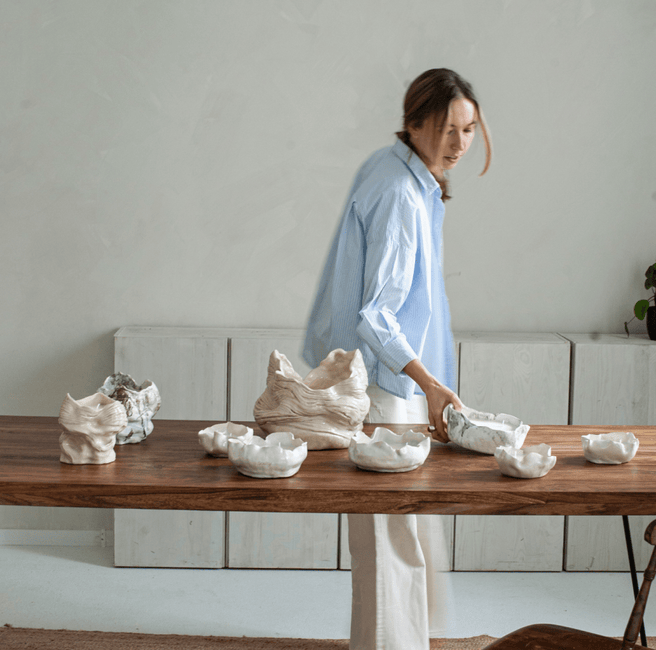
Still, certain things remain. Music is always present, shaping the atmosphere in which she works. The space stays minimal, a few tools, a surface, the piece in progress. Cleanliness, too, becomes part of the practice, allowing for a clearer state of mind.
For Ieva, ceramics has become a space she steps into.
“My craft is an escape into my inner room,” she says, “where there is only me and the material I work with.” Through repetition, she builds not only form, but also patience and confidence in what she is doing.
As she continues, different ideas begin to meet within the work. Art, craftsmanship, ancient worlds, mythical consciousness, femininity, even alchemy, all gradually find their place within her practice.
How does living closer to nature affect your creative or everyday life?
“In every possible way,” she says. “But most importantly, I feel truly alive here.” Life around her moves in its own rhythm, steady and continuous, and something in her follows that.
“It seems that any winds can blow in life,” she reflects, “but around you, the same uninterrupted cycle continues.”

Photo by: Vita Vilkeliškytė
She is beginning to trust that.
“I am learning to let go,” she says, “to trust in nature, to listen to myself as an artist, as a woman, as part of this world.”
For more on Ieva’s work and ongoing projects, visit her degahandbuilt.com
Photographed by: vitavilkeliskyte.com